
If you’ve ever run network cables through a commercial building, installed security cameras, or set up a paging system, you’ve worked with low voltage wiring, whether you realized it or not. But what is considered low voltage wiring, exactly? The answer matters more than most business owners think, because it affects everything from building codes and contractor licensing to how your infrastructure performs over time.
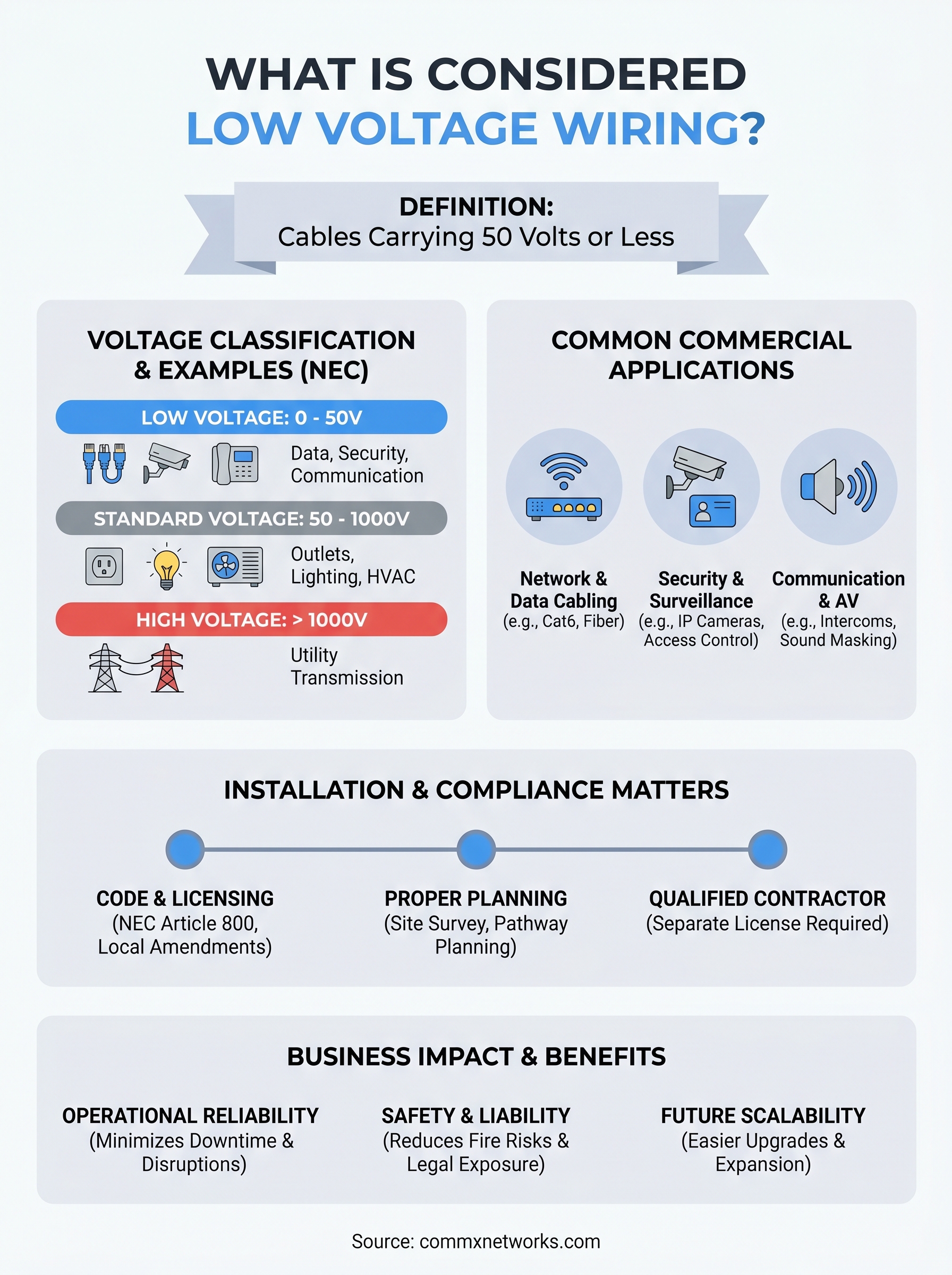
Low voltage wiring refers to cables that carry 50 volts or less, which separates it from the standard 120V or 240V electrical circuits that power your lights, HVAC, and outlets. It covers a wide range of commercial systems: structured data cabling, Wi-Fi access points, security cameras, intercoms, and sound masking, all of which are systems we design and install at CommX Networks across Southwest Florida’s commercial properties.
This article breaks down the voltage thresholds that define low voltage, the most common applications in commercial environments, how it differs from standard electrical work, and why proper installation standards matter for long-term reliability. Whether you’re planning a new facility buildout or upgrading an existing space, understanding low voltage wiring is a practical first step.
Why low voltage wiring matters in commercial spaces
Most commercial building projects focus budget and attention on structural work and high-voltage electrical, but low voltage wiring is the backbone of nearly every system your staff interacts with every day. Your network infrastructure, security cameras, Wi-Fi access points, and paging systems all run on low voltage circuits, and when that wiring fails or gets installed incorrectly, the disruption hits fast and runs deep. Understanding what is considered low voltage wiring is the first step toward treating it with the seriousness it deserves in any commercial buildout.
How low voltage systems affect daily operations
The systems that keep your business running, from internet connectivity to surveillance to intercoms, depend entirely on clean, properly routed low voltage cabling. A weak cable run or an improperly terminated connector introduces signal loss, which shows up as slow network speeds, dropped Wi-Fi connections, or security camera feeds that cut in and out. In a warehouse, distribution center, or large office complex, those failures don’t just cause frustration; they slow down workflows and create real financial loss.
Your staff and daily workflows depend on infrastructure they never think about. A well-designed low voltage infrastructure means reliable performance across the entire footprint of your facility, whether you’re running 10 workstations or 500.
A single improperly terminated Cat6 run can reduce your network speed from 1 Gbps to under 100 Mbps, enough to grind productivity to a halt in a data-heavy environment.
Code compliance and contractor licensing
Low voltage wiring falls under specific building codes and licensing requirements that vary by state and municipality. In Florida, contractors who install low voltage systems need the appropriate license, separate from a standard electrician’s license, because the work involves data, communication, and security systems governed by the National Electrical Code (NEC), Article 800 and related low voltage articles. Hiring an unlicensed contractor to handle this work puts your building permit, your insurance coverage, and your occupancy certificate at risk.
Beyond permits, improper installation creates liability. If a fire starts due to incorrectly installed cabling in a plenum space, or if your security system fails during a break-in because of bad wiring, the paper trail matters. Working with a licensed and insured low voltage contractor from the start protects your investment and keeps your facility compliant.
Scalability and infrastructure longevity
Commercial spaces change. You add workstations, expand to new floors, or bring on new technology that requires additional cabling runs. Low voltage infrastructure built to current standards, such as Cat6 or fiber optic backbone cabling, gives your facility room to grow without requiring a full rewire. Planning your cabling around anticipated growth and technology upgrades saves significant cost down the road.
Common upgrades that benefit from a scalable low voltage foundation include:
- Additional wireless access points for expanded coverage
- IP security cameras in new zones
- VoIP phone systems and overhead paging
- Digital signage and conferencing room technology
What voltage counts as low voltage in the US
Defining what is considered low voltage wiring comes down to a specific number: 50 volts or less. The National Electrical Code (NEC), which serves as the baseline for electrical standards across the United States, uses this threshold to distinguish low voltage systems from the standard 120V or 240V circuits that power outlets, lighting, and HVAC equipment. Understanding where that line sits helps you make better decisions when planning a commercial infrastructure project.
The 50-volt threshold and NEC classifications
The NEC breaks down low voltage systems into several articles based on the type of signal being carried. Article 800 covers communication circuits (telephone and data), Article 820 covers coaxial cables for video, and Article 725 governs remote-control and signaling circuits. Each category has its own installation rules, but they all operate below the 50-volt ceiling that separates low voltage from line voltage work.
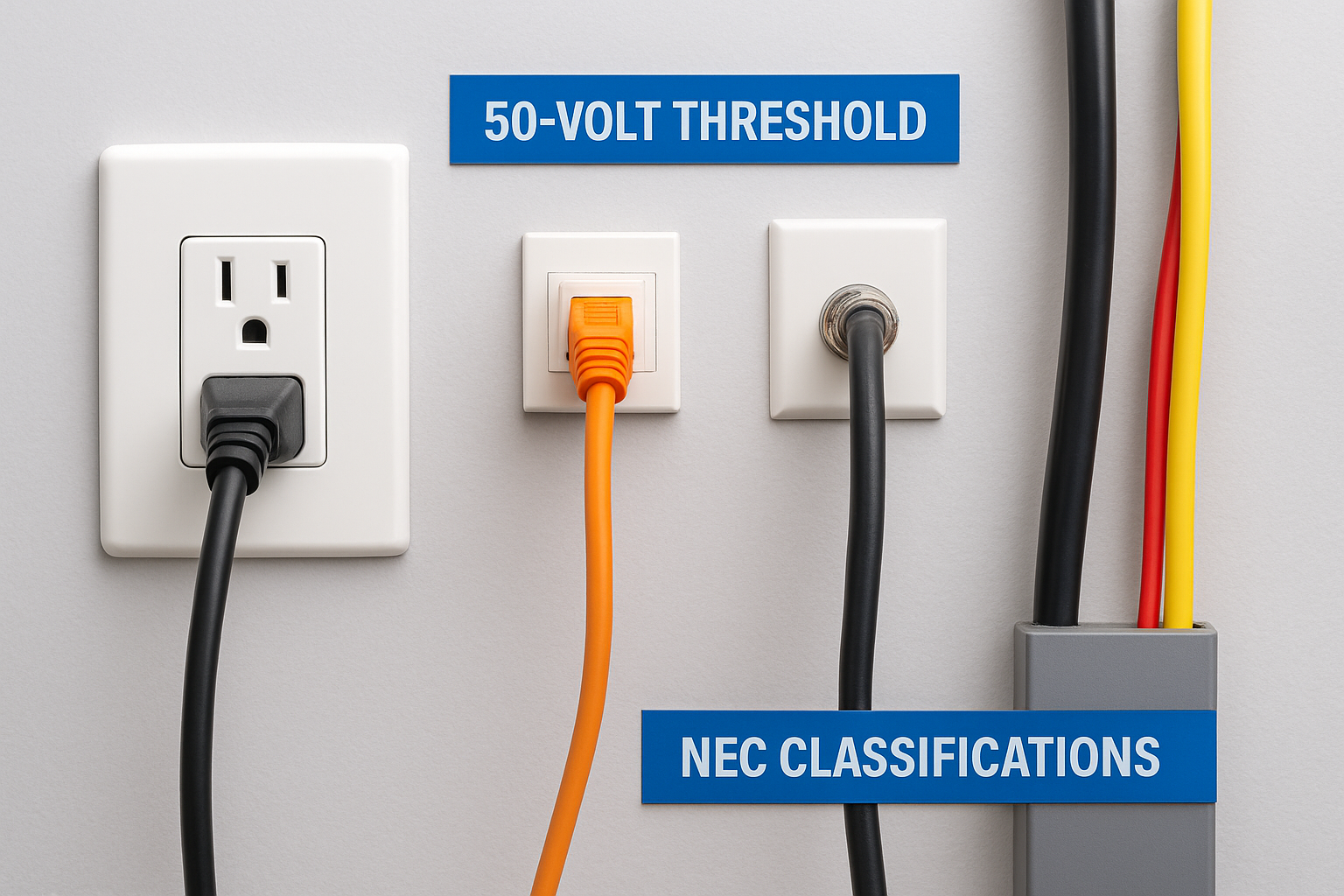
Mixing low voltage cabling with high voltage wiring in the same conduit or pathway violates NEC code and can damage equipment or create fire hazards, especially in plenum-rated spaces.
| Voltage Range | Classification | Common Examples |
|---|---|---|
| 0 to 50V | Low voltage | Network cables, security cameras, intercoms |
| 50V to 1,000V | Standard voltage | Outlets, lighting, HVAC |
| Above 1,000V | High voltage | Utility transmission lines |
How Florida and local codes apply these standards
Florida follows the NEC as its base electrical code, but local municipalities can adopt amendments that add requirements on top of the national standard. In Southwest Florida, this means your Fort Myers or Naples project may carry specific permit and inspection requirements tied to low voltage installations. Working with a licensed low voltage contractor familiar with local authority having jurisdiction (AHJ) rules keeps your project on track and your certificate of occupancy protected. Always verify which code cycle your county has adopted before starting any cabling work.
Common low voltage systems and cable types
Understanding what is considered low voltage wiring becomes much clearer when you look at the specific systems it powers in a commercial building. These systems span data, security, and communication, and each one relies on a specific cable type engineered for its signal requirements. Choosing the wrong cable for a given application is one of the most common and costly mistakes in commercial infrastructure projects.
Network and data cabling
Structured cabling forms the core of most commercial low voltage installations. For most businesses, Cat6 copper cabling handles workstation connections, VoIP phones, and access points, supporting speeds up to 10 Gbps over short distances. Larger facilities or those with high data throughput demands, such as distribution centers or multi-floor office complexes, typically use a fiber optic backbone to connect their main distribution frame (MDF) to intermediate distribution frames (IDFs) across the building.
Cat6 cabling is backward compatible with older Cat5e infrastructure, but running Cat6 from the start avoids costly upgrades as your bandwidth demands grow.
| Cable Type | Max Speed | Common Use |
|---|---|---|
| Cat6 | 10 Gbps (up to 55m) | Workstations, VoIP, access points |
| Cat6A | 10 Gbps (up to 100m) | High-density environments |
| Single-mode fiber | 100+ Gbps | Long-distance backbone runs |
Security and surveillance systems
IP security cameras run on low voltage cabling, typically Cat6, using Power over Ethernet (PoE) to receive both data and power through a single cable run. Access control systems, including card readers and door strikes, also fall under the low voltage category and require careful cable routing to function reliably across large commercial footprints.
Communication and AV systems
Overhead paging systems, intercoms, and sound masking all operate on low voltage circuits and use dedicated cable types suited to audio signal transmission. In open office environments, sound masking systems use plenum-rated low voltage cable routed above the ceiling grid to distribute white noise evenly and reduce speech intelligibility across the workspace.
How low voltage wiring is installed in businesses
Installing low voltage wiring in a commercial space follows a structured process that starts well before any cable gets pulled through a wall. Proper planning determines whether your infrastructure performs reliably for years or causes constant maintenance headaches. For any project where what is considered low voltage wiring matters, the installation sequence is as important as the cable type you choose.
Site survey and pathway planning
Every professional low voltage installation begins with a detailed site survey that maps your existing pathways, identifies conduit runs, and locates the MDF and IDF closets your cabling will terminate into. Your contractor needs to account for fire-rated walls, plenum ceiling spaces, and code-required separation from high-voltage electrical runs before a single cable gets installed. Skipping this step leads to costly rework when inspectors flag improper cable routes during permitting.
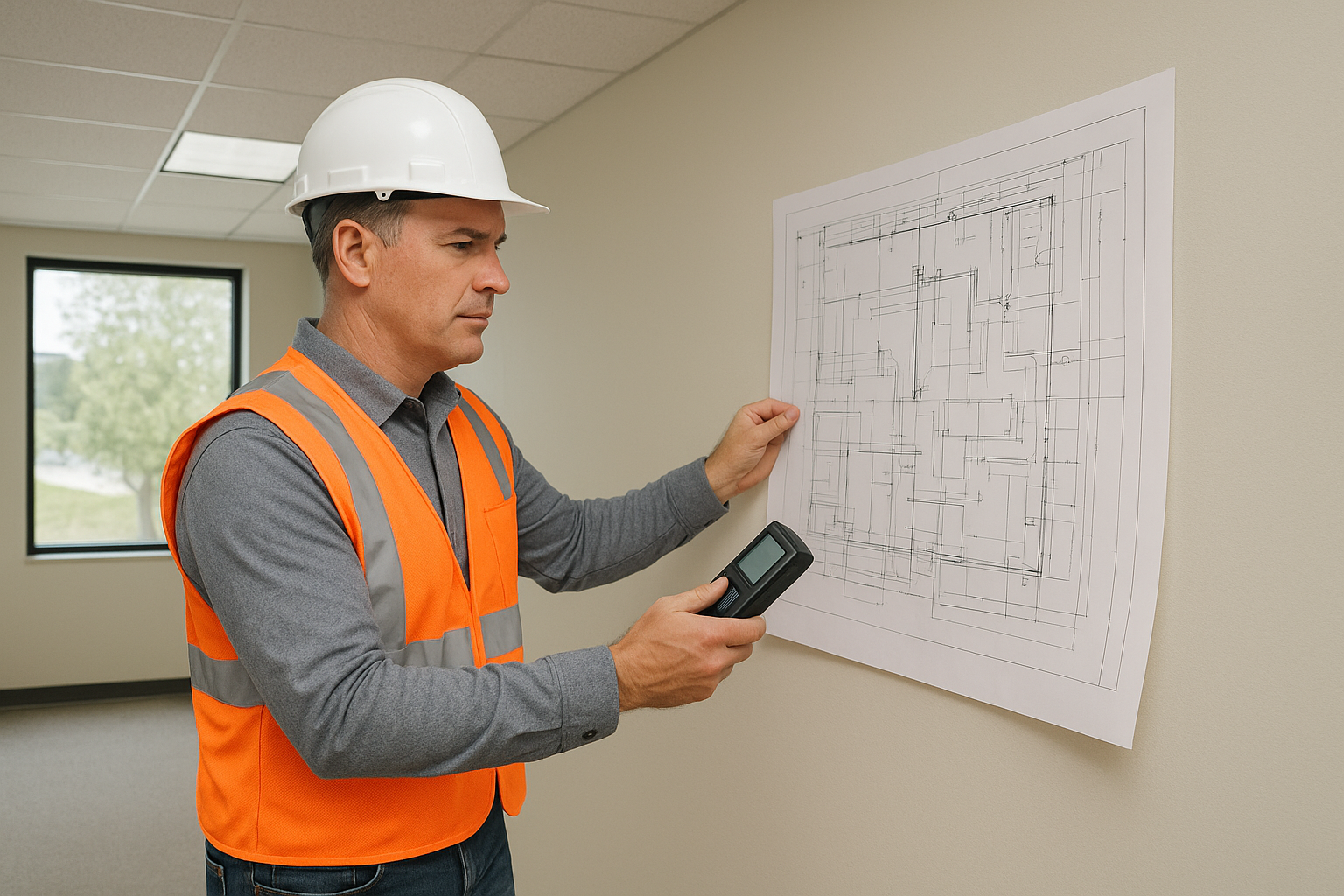
Running low voltage cable within 2 inches of fluorescent lighting or power conduit without proper separation introduces interference that degrades signal quality across your entire network.
Cable pulling and termination
Once pathways are confirmed, the physical installation begins with pulling cable from the distribution point to each endpoint, whether that’s a wall plate, camera mount, or access point location. Each cable run gets labeled at both ends and tested with a cable tester to confirm continuity and performance before the contractor terminates it into patch panels or keystone jacks in the IDF closet. Proper termination technique, specifically maintaining the twist rate of each wire pair up to the point of connection, is what separates a reliable installation from one that underperforms from day one.
Testing and documentation
After termination, your contractor should provide full cable test reports for every run using a certified tester that validates the installation meets TIA-568 standards. Accurate documentation, including cable labels, panel schedules, and as-built drawings, becomes essential when you expand your facility or troubleshoot issues down the road.
Mistakes to avoid and how to troubleshoot
Even when you understand what is considered low voltage wiring, installation errors can undermine your entire infrastructure investment. The most expensive problems in commercial low voltage projects are not caused by bad equipment; they come from shortcuts taken during the planning and installation phase that only surface weeks or months after the job is complete.
Common installation mistakes
Ignoring cable bend radius limits is one of the fastest ways to degrade network performance without any visible damage. Cat6 cable has a minimum bend radius, and forcing it around tight corners or stapling it flat against a wall surface crushes the wire pairs inside, introducing signal loss that no amount of troubleshooting will fix without replacing the run entirely.
Pulling cable with more than 25 lbs of tension stretches the conductors inside Cat6 and permanently damages the cable’s performance characteristics, even if it passes a basic continuity test.
Failing to separate low voltage cable from high-voltage conduit is another mistake that causes interference across your entire network. Your security cameras, Wi-Fi access points, and data connections all carry signals sensitive to electromagnetic interference generated by power circuits running nearby. NEC code requires specific separation distances for good reason, and ignoring them creates problems you will spend hours chasing.
How to troubleshoot signal and performance issues
When network speeds drop or security camera feeds become unstable, start at the physical layer before assuming your switches or hardware are at fault. Pull up your cable test documentation and identify any runs that tested near the minimum acceptable threshold during installation. Those marginal runs are the first place to inspect when performance degrades.
Loose patch cables, improperly seated keystone jacks, and unlabeled runs cause a significant portion of ongoing network issues in commercial facilities. Walk your IDF closets and verify that every connection is fully seated, every cable is labeled, and no patch cable shows visible damage at the connector boot.
Next steps
Now that you understand what is considered low voltage wiring, the voltage thresholds that define it, and the systems it powers, you are in a much better position to plan or evaluate your commercial infrastructure. Proper low voltage installation is not something to hand off to whoever is cheapest or most available; it directly affects your network reliability, security system performance, and long-term ability to scale without expensive rework.
If your Fort Myers, Cape Coral, or Naples facility needs structured cabling, Wi-Fi infrastructure, IP security cameras, or sound masking installed to current NEC standards, working with an experienced and licensed contractor matters from day one. CommX Networks has spent 18 years designing and installing commercial low voltage systems across Southwest Florida, handling projects from small office buildouts to large-scale warehouse environments. Reach out to our team at CommX Networks to discuss your project requirements and get a plan built around your facility’s specific needs.