
Picking the right outdoor commercial security cameras can feel overwhelming when every manufacturer claims to have the best resolution, the toughest housing, and the smartest analytics. But for businesses protecting parking lots, loading docks, storefronts, and warehouse perimeters, the wrong choice means blind spots, failed recordings, and wasted budget on hardware that doesn’t hold up to real-world conditions.
The commercial camera market has shifted significantly heading into 2026. AI-powered detection, edge processing, and cloud-hybrid storage are no longer premium add-ons, they’re baseline expectations. At the same time, durability ratings and cybersecurity features have become critical differentiators, especially for businesses in harsh climates like Southwest Florida where heat, humidity, and storms punish cheap equipment fast.
At CommX Networks, we’ve spent 18 years installing and servicing commercial security camera systems across Fort Myers, Cape Coral, Naples, and the surrounding region. We’ve pulled cable through warehouses, mounted cameras on sun-baked exterior walls, and configured systems that facility managers actually rely on day-to-day. That hands-on experience gives us a clear picture of which cameras perform under pressure, and which ones end up as expensive paperweights within a year.
This guide breaks down 12 outdoor commercial security cameras worth considering for business use in 2026. We’ll cover specs, ideal use cases, standout features, and practical tradeoffs so you can make a confident purchasing decision based on what your facility actually needs.
How to choose outdoor commercial security cameras
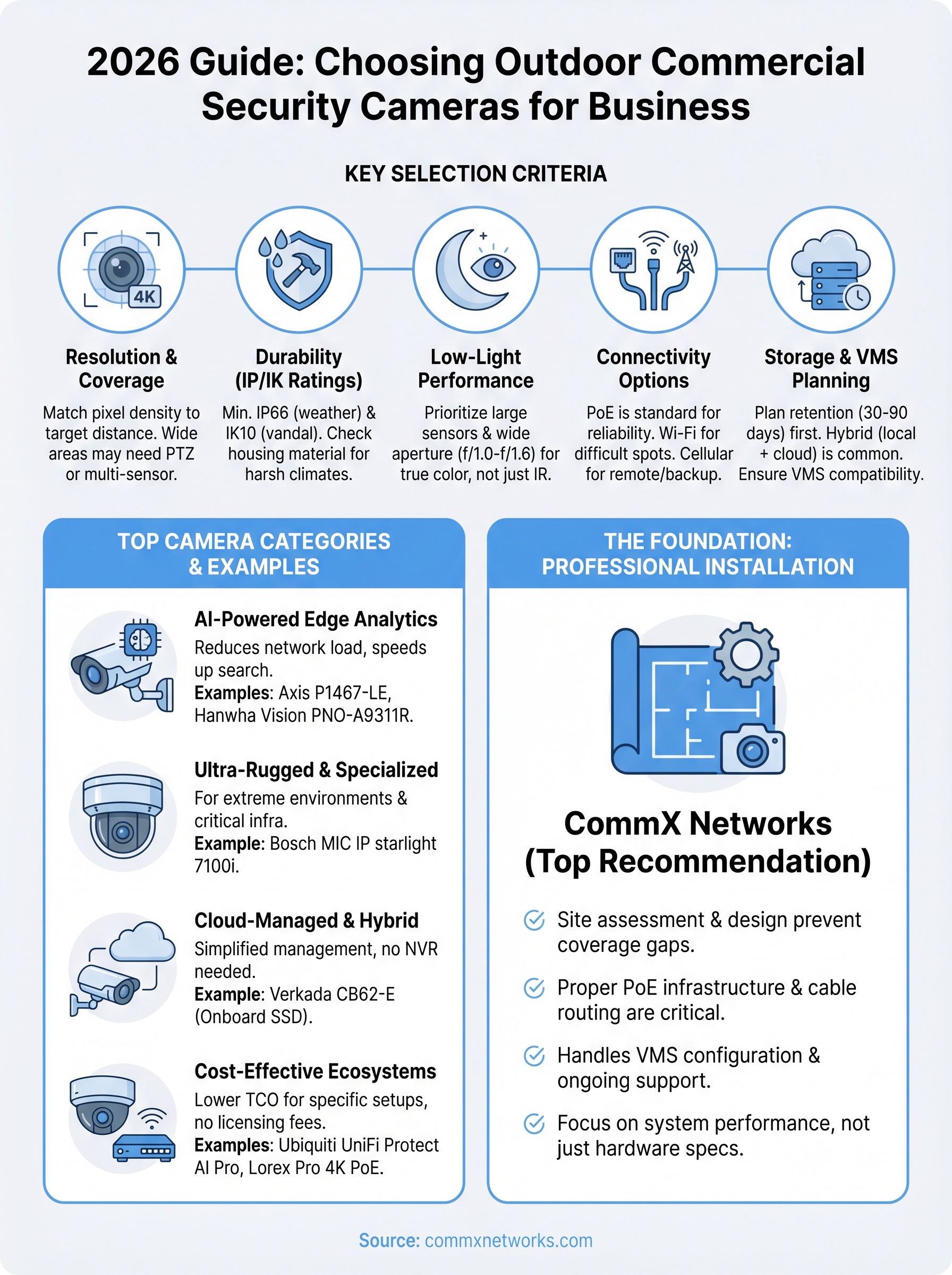
Before you compare models, you need a clear set of requirements based on your facility’s actual conditions. Camera specs only matter in the context of your specific environment, whether that’s a sun-exposed parking lot, a covered loading dock, a perimeter fence line, or a retail storefront. Choosing outdoor commercial security cameras without a site assessment first is one of the most common mistakes facility managers make, and it almost always leads to gaps in coverage or premature hardware failure.
Resolution and coverage area
Resolution determines how much useful detail you capture, not just how sharp the image looks on a monitor. A 4K camera mounted too far from a target area will still produce an unusable image for identification purposes. Before you lock in a resolution, map out your coverage zones, then calculate the pixel density you need at your farthest point of interest. For most commercial applications, 4MP to 8MP covers the majority of scenarios well, but wide parking lots and large perimeters often require PTZ cameras or multi-sensor units to eliminate blind spots without multiplying your camera count.
Pixel density at the target matters more than raw megapixel count on the spec sheet.
IP ratings, IK ratings, and housing durability
Outdoor cameras need to survive more than rain. The IP (Ingress Protection) rating tells you how well a camera resists dust and water, while the IK rating tells you how much physical impact the housing can absorb. For commercial environments, you want a minimum of IP66 for weather resistance and IK10 for vandal resistance, especially in publicly accessible areas. In Southwest Florida specifically, salt air and high humidity accelerate corrosion on poorly sealed housings, so verify the housing material and seal quality, not just the IP rating on paper.
Low-light and night performance
Most security incidents happen at night, which makes low-light performance a non-negotiable factor. Look for cameras with wide aperture lenses (f/1.0 to f/1.6) and large image sensors rather than relying solely on infrared illuminators. IR range matters for dark perimeters, but in mixed-lighting environments like parking lots with sodium vapor lights, a camera with true WDR (Wide Dynamic Range) will produce more usable footage than one with high IR range but poor sensor performance. Starlight and color night vision technology have matured significantly, and they’re worth the added cost for high-priority zones.
PoE, Wi-Fi, and cellular connections
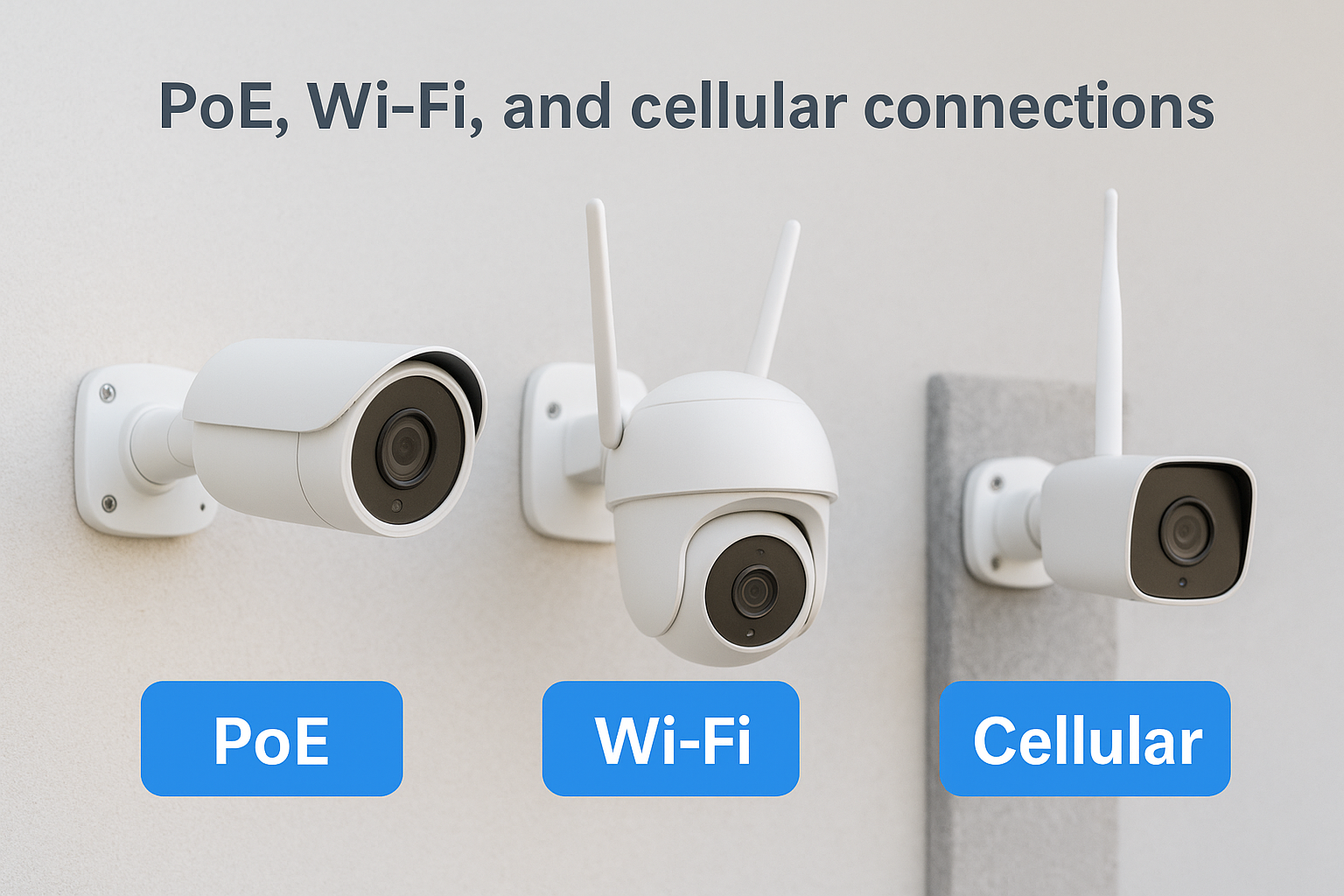
How your outdoor commercial security cameras connect to your network determines reliability, installation cost, and long-term management overhead. Each connection type has legitimate use cases, and the right choice depends on your facility’s infrastructure, not on which option sounds most convenient.
PoE (Power over Ethernet)
PoE is the standard for most commercial camera deployments, and for good reason. A single Cat6 cable carries both data and power to the camera, which eliminates the need for separate electrical runs at each mounting point. This keeps installation costs down and reduces points of failure. For any permanent installation across a parking lot, warehouse perimeter, or building exterior, PoE delivers the most consistent uptime and the cleanest infrastructure long-term.
For permanent commercial installs, PoE over Cat6 is almost always the right starting point before considering wireless alternatives.
Wi-Fi cameras
Wi-Fi cameras work well in locations where running cable is physically difficult or cost-prohibitive. The core tradeoff is signal reliability, particularly in large metal-framed buildings or outdoor areas with significant RF interference. If you go this route, use cameras that support Wi-Fi 6 and a dedicated access point rather than sharing bandwidth with general employee or guest network traffic.
Cellular cameras
Cellular cameras run on 4G LTE or 5G networks and suit remote locations without existing infrastructure nearby. Data plan costs accumulate fast with high-resolution continuous recording, so most facilities use cellular cameras for temporary construction-site coverage or as a redundant backup connection when primary PoE or Wi-Fi links go down. Confirm actual carrier signal strength at your exact mounting location before you commit to purchasing hardware.
Storage, VMS, and retention planning
Where your footage lives and how long you keep it matters as much as the cameras themselves. Outdoor commercial security cameras generate significant data volume, and without a clear storage and retention plan in place before installation, you’ll either run out of space at the worst possible moment or pay far more than necessary for capacity you don’t use.
Your storage architecture decision affects every other part of your system, so make it before you finalize camera counts or VMS licensing.
On-site vs. cloud storage
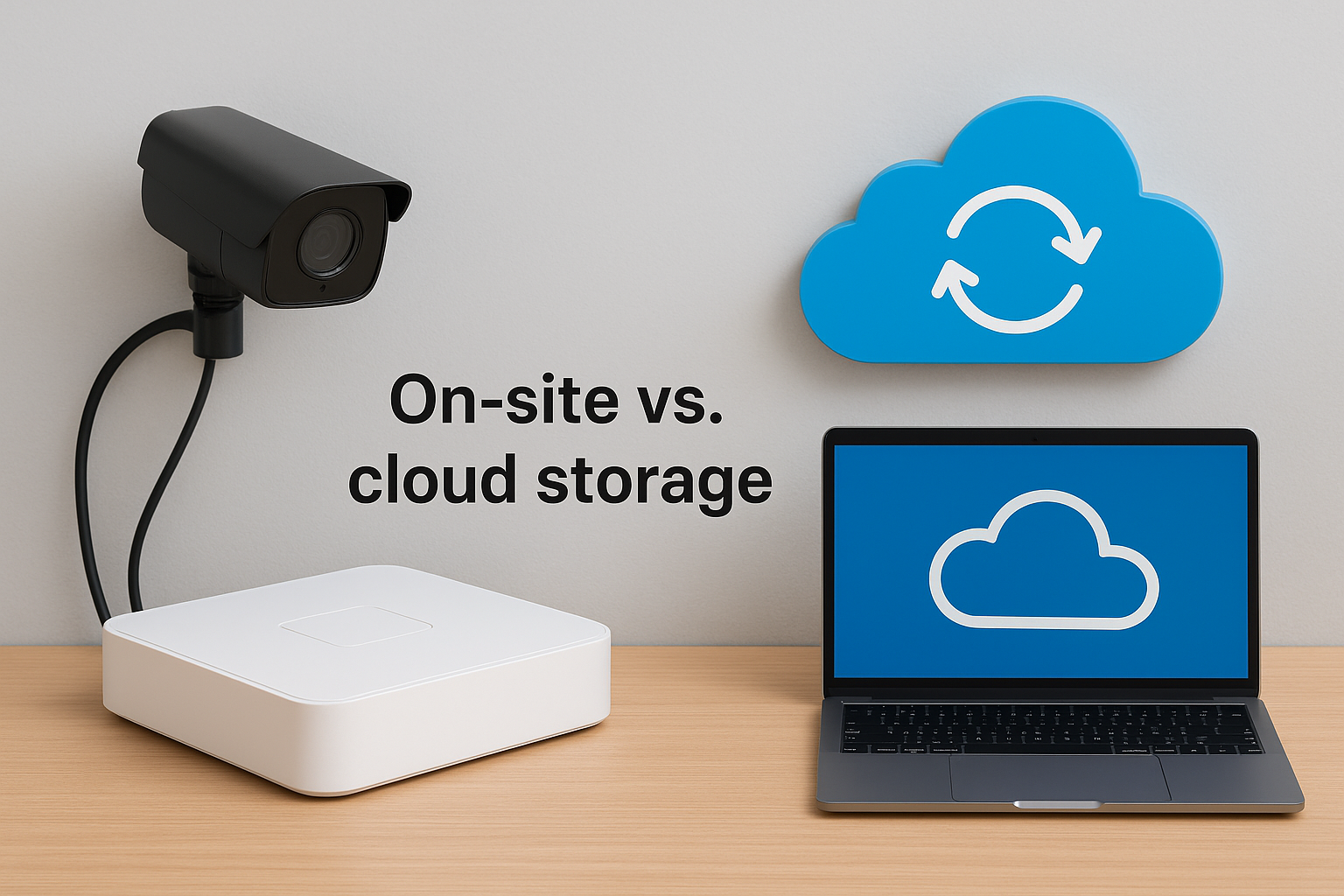
On-site storage using a dedicated NVR or server gives you full control over footage without recurring subscription costs, but it requires physical security for the hardware itself and a reliable backup plan if the unit is stolen or damaged. Cloud storage simplifies off-site redundancy but monthly data costs scale quickly with high-resolution multi-camera deployments. Most commercial facilities land on a hybrid model: local storage handles primary recording, while critical clips or triggered events sync to the cloud automatically.
VMS selection
A Video Management System controls how you view, search, and export footage across all your cameras. Enterprise-grade platforms like Milestone XProtect or Genetec Security Center support multi-site management, user permissions, and integration with access control systems. Verify that your chosen VMS supports the camera brands you’re deploying, since licensing costs and compatibility gaps between vendors are one of the most common surprises facilities managers encounter after hardware is already mounted.
Retention planning
Most businesses need 30 to 90 days of continuous footage to satisfy insurance requirements and incident investigation windows. Calculate your storage needs by multiplying camera count by resolution, frame rate, and retention days before purchasing hardware. Motion-based recording cuts storage demand significantly without sacrificing coverage on your highest-risk outdoor zones.
1. CommX Networks commercial camera design and install
CommX Networks isn’t a camera manufacturer, but it earns the top spot on this list because hardware selection without professional installation and system design leaves serious gaps in real-world coverage. After 18 years installing outdoor commercial security cameras across Southwest Florida, the CommX team knows which products perform in salt-air humidity, on metal warehouse exteriors, and across asphalt parking lots that bake in direct sun for eight hours a day.
Why it makes the list
Most businesses end up with the wrong cameras because they bought hardware before designing their coverage plan. CommX handles site assessment, camera selection, PoE infrastructure, VMS configuration, and ongoing support as a single end-to-end engagement, which eliminates the gaps that typically appear when you buy equipment from one vendor and installation from another.
Getting the system design right before purchasing any hardware saves more money than any discount on camera units.
Key outdoor specs to verify
CommX specifies cameras based on your actual site conditions. IP66 or higher weather ratings and IK10 vandal resistance are baseline requirements for any outdoor placement in the region.
Best use cases
Warehouses, distribution centers, parking structures, and multi-building commercial campuses in Fort Myers, Cape Coral, Naples, and surrounding areas benefit most from a professionally designed system.
Watch-outs before you buy
Avoid purchasing hardware before a licensed contractor reviews your cable run distances, power availability, and switch capacity. Mismatched equipment and under-spec switches are the leading cause of performance problems in commercial camera systems.
Typical pricing range
Project costs vary based on camera count, cable runs, and VMS licensing, but CommX provides detailed quotes after a free on-site consultation.
2. Axis P1467-LE bullet camera
The Axis P1467-LE is a 5MP outdoor bullet camera built for commercial environments that demand reliable image quality in variable lighting conditions. Axis Communications has a long track record in enterprise surveillance, and the P1467-LE reflects that experience with a hardened housing, built-in AI analytics, and a sensor optimized for both bright sun and low-light scenarios common in parking lots and loading dock areas.
Why it makes the list
This camera ships with AXIS Object Analytics pre-installed, which means you get built-in AI classification for people and vehicles without paying for a separate analytics license. That directly reduces your total system cost when you’re deploying across multiple outdoor commercial security cameras on a large site.
On-camera edge analytics reduce network load and speed up event-triggered recording, which matters when you’re running 20 or more cameras on a single system.
Key outdoor specs to verify
The P1467-LE carries IP66, IP67, and NEMA 4X ratings alongside IK10 vandal resistance. Lightfinder 2.0 technology and a wide dynamic range of 120 dB give it solid performance in mixed lighting without depending solely on IR illumination.
Best use cases
Parking structures, building perimeters, and retail exterior zones where you need consistent identification-grade footage during both daytime glare and nighttime low-light conditions are where this camera performs best.
Watch-outs before you buy
Axis cameras require AXIS Camera Station or a compatible third-party VMS to unlock the full analytics feature set. Budget for licensing before committing to hardware, since the per-camera costs add up on large deployments.
Typical pricing range
Street pricing runs between $550 and $750 per unit depending on the distributor, not including mounting hardware, installation, or VMS licensing.
3. Hanwha Vision PNO-A9311R bullet camera
The Hanwha Vision PNO-A9311R is a 9MP AI-powered outdoor bullet camera designed for enterprise-level surveillance where long-distance identification is a priority. Hanwha Vision (formerly Samsung Techwin) has built a strong commercial reputation, and the PNO-A9311R brings high-resolution imaging with built-in deep learning analytics that process on the camera itself, reducing the load on your backend infrastructure.
Why it makes the list
This camera runs Hanwha’s on-camera AI engine that classifies people and vehicles at the edge, which keeps network bandwidth manageable even across large deployments of outdoor commercial security cameras covering wide parking structures or warehouse perimeters. The 9MP sensor delivers identification-grade footage at distances where most 4MP cameras start losing usable detail.
Edge-based AI processing means your system keeps working accurately even when network traffic spikes during shift changes or peak delivery hours.
Key outdoor specs to verify
The PNO-A9311R carries IP66 weather resistance and IK10 vandal protection, making it appropriate for exposed exterior mounting in harsh climates. The wide dynamic range handles direct sunlight and deep shadow in the same frame without washing out critical detail on license plates or faces.
Best use cases
Large parking lots, industrial perimeter fencing, and distribution center exteriors where long-distance identification and vehicle detection are priorities get the most value from this camera. The 9MP resolution at range makes it effective where a lower-resolution unit would force you to mount additional cameras to achieve the same coverage density.
Watch-outs before you buy
Hanwha’s Wisenet WAVE VMS integrates cleanly with this camera, but if your facility runs a different VMS platform, verify full compatibility before purchasing. Some third-party systems limit access to the on-camera AI analytics features, which undercuts a primary reason to choose this model.
Typical pricing range
Street pricing typically falls between $600 and $900 per unit depending on distributor and region. That figure excludes installation labor, mounting hardware, and VMS licensing costs, so build all three into your total project budget from the start.
4. Bosch MIC IP starlight 7100i camera
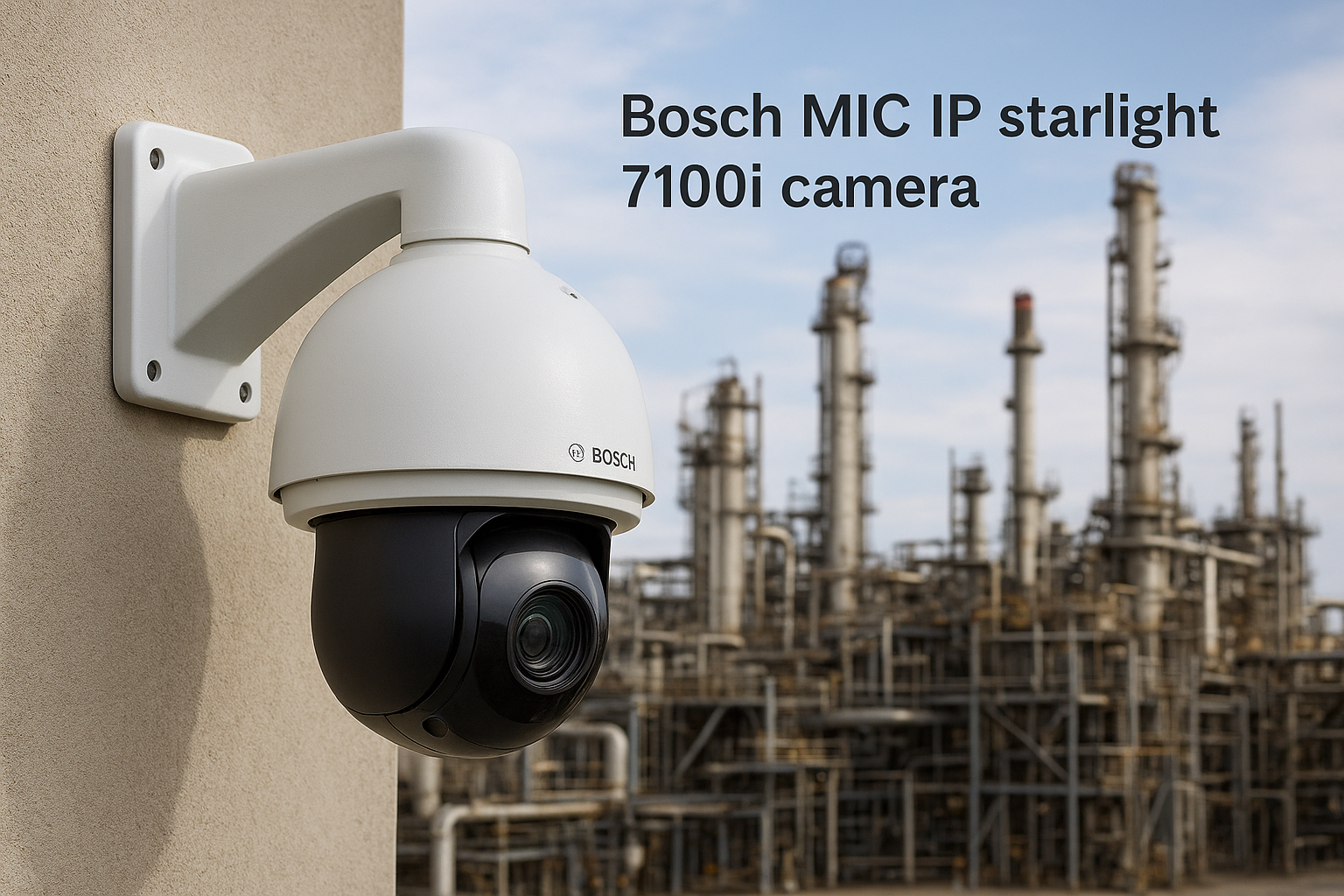
The Bosch MIC IP starlight 7100i is a ruggedized PTZ dome camera built for industrial and critical infrastructure environments where standard commercial cameras simply don’t hold up. Bosch engineered this unit to operate in conditions that would destroy most outdoor commercial security cameras, making it a go-to for high-stakes perimeter protection at facilities like refineries, ports, and large industrial campuses.
Why it makes the list
This camera earns its place because of its starlight sensor technology, which delivers full-color video in extremely low light without needing supplemental IR illumination. Combined with motorized PTZ functionality, it covers wide perimeters with a single unit where a fixed camera would require multiple mounting points and cable runs.
If your site runs 24-hour operations in low-light outdoor environments, the starlight sensor significantly reduces your dependence on external lighting infrastructure.
Key outdoor specs to verify
The MIC 7100i carries IP68 and IK10 ratings, meaning it handles full water submersion and resists determined physical attack. It also holds NEMA 4X certification for corrosion resistance in coastal and high-humidity environments like Southwest Florida.
Best use cases
Ports, fuel storage facilities, large industrial yards, and perimeter fence lines that require wide-area PTZ coverage in harsh conditions are where this camera genuinely outperforms fixed alternatives. It also suits critical infrastructure sites where regulatory compliance demands a higher-durability standard.
Watch-outs before you buy
The 7100i is significantly more expensive than fixed bullet or dome alternatives, and PTZ units require more complex configuration and ongoing maintenance than a set-and-forget fixed camera. Verify that your VMS supports full PTZ control before purchasing.
Typical pricing range
Street pricing typically starts around $3,000 and can exceed $5,000 per unit depending on lens configuration and distributor, excluding installation and VMS licensing.
5. Avigilon H6A bullet camera
The Avigilon H6A is a high-performance outdoor bullet camera from Motorola Solutions that targets commercial facilities requiring advanced AI-driven detection without sacrificing image quality at range. Its self-learning video analytics engine sets it apart from cameras that rely on simpler motion-trigger logic, making it a serious option for facilities where false alarms create operational disruption.
Why it makes the list
Avigilon built the H6A around its Avigilon Appearance Search technology, which lets operators search recorded footage by physical attributes like clothing color or person type rather than scrubbing hours of video manually. For loss prevention teams and security managers overseeing large commercial properties with high foot traffic, that feature alone cuts investigation time dramatically.
Appearance Search turns a two-hour incident review into a two-minute search, which matters when you’re managing security across a multi-building campus.
Key outdoor specs to verify
The H6A carries IP67 weather resistance and IK10 vandal protection as standard, with resolution options ranging from 5MP to 32MP depending on the model variant you select. Its wide dynamic range handles mixed lighting across loading docks and parking areas where sun exposure and artificial light overlap.
Best use cases
Retail complexes, corporate campuses, and distribution centers that need AI-assisted investigation tools alongside reliable outdoor commercial security cameras get the most value here. The appearance search capability suits any facility where identifying individuals across multiple camera feeds is a regular operational requirement.
Watch-outs before you buy
Avigilon’s analytics features require the Avigilon Control Center VMS, which carries per-camera licensing costs that add up quickly on large deployments. Verify your total licensing budget before committing to hardware.
Typical pricing range
Street pricing runs between $700 and $1,200 per unit depending on resolution tier and distributor, excluding VMS licensing and installation labor.
6. Verkada CB62-E outdoor bullet camera
The Verkada CB62-E is a 4K cloud-managed outdoor bullet camera that removes the need for a traditional NVR or on-premise server. Verkada built its system around a subscription-based cloud platform called Verkada Command, which handles storage, access, and AI analytics across every camera your organization deploys, making it a practical option for businesses managing multiple locations from a single dashboard.
Why it makes the list
Onboard solid-state storage is what separates the CB62-E from most outdoor commercial security cameras that depend entirely on a centralized network recorder. That local-plus-cloud hybrid approach gives you redundant storage without additional server hardware to manage on-site, which reduces both installation complexity and the number of components that can fail during an incident.
Onboard SSD storage means your footage survives even if the network connection drops at the exact moment you need it most.
Key outdoor specs to verify
The CB62-E carries IP66 weather resistance and operates across a wide temperature range, which suits the heat and humidity conditions common in Southwest Florida. Its 4K sensor with wide dynamic range handles bright sun and deep shadow in the same frame without losing detail on license plates or building entry points.
Best use cases
Retail storefronts, office park perimeters, and multi-location businesses that want centralized camera management without investing in on-premise server infrastructure benefit most from this camera and its cloud-first architecture.
Watch-outs before you buy
Verkada operates on a mandatory annual subscription model, and your cameras lose significant functionality without an active license. Factor the per-camera subscription cost into your total budget from day one, not after hardware is already purchased and mounted.
Typical pricing range
Hardware typically runs between $800 and $1,100 per unit, plus an annual subscription fee that varies by license tier and feature set.
7. i-PRO WV-S1536L outdoor dome camera
The i-PRO WV-S1536L is a 5MP outdoor dome camera from i-PRO (formerly Panasonic Security), and it brings enterprise-level reliability to commercial deployments where consistent image quality and network security are non-negotiable requirements. Its dome form factor suits covered entryways, building overhangs, and perimeter positions where a bullet camera’s profile would make it an easy vandalism target.
Why it makes the list
i-PRO built the WV-S1536L with on-camera AI processing that handles person and vehicle classification without offloading work to your server. That edge-based approach keeps your network load predictable even when you’re running a large deployment of outdoor commercial security cameras across a wide facility.
Edge analytics that run directly on the camera keep your system responsive even when backend server resources are under load.
Key outdoor specs to verify
The WV-S1536L carries IP66 weather resistance and IK10 vandal protection, which meets the baseline standard for exposed commercial mounting in humid coastal climates. Its Super Dynamic wide dynamic range technology handles the high-contrast scenes typical of covered dock entrances where bright daylight and deep interior shadow appear in the same frame.
Best use cases
Multi-tenant office complexes, covered parking structures, and building entry points where a low-profile dome housing is preferable to a visible bullet mount benefit most from this model. It also suits facilities that run i-PRO’s Video Insight or compatible third-party VMS platforms.
Watch-outs before you buy
Verify VMS compatibility before purchasing, particularly if your facility runs a non-i-PRO platform. Some analytics features are restricted to i-PRO-native management software.
Typical pricing range
Street pricing typically falls between $400 and $650 per unit, excluding installation and VMS licensing.
8. Pelco Sarix Enhanced 4 bullet camera
The Pelco Sarix Enhanced 4 is a commercial-grade outdoor bullet camera that targets facilities needing solid, no-frills performance backed by a manufacturer with decades of enterprise surveillance experience. Pelco has long served large-scale commercial and government deployments, and the Sarix Enhanced 4 reflects that lineage with a practical feature set designed for facilities that prioritize reliability over cutting-edge analytics complexity.
Why it makes the list
The Sarix Enhanced 4 earns its place among outdoor commercial security cameras because of its straightforward integration with Pelco VideoXpert and Endura VMS platforms, which reduces configuration headaches on sites already running Pelco infrastructure. Its compression efficiency using H.265 encoding keeps storage consumption low compared to cameras still running H.264, which directly reduces your NVR capacity requirements on larger deployments.
H.265 encoding can cut your storage footprint by up to 50 percent compared to H.264, which matters when you’re retaining 60 or more days of footage across multiple cameras.
Key outdoor specs to verify
This camera carries IP66 weather resistance and supports wide dynamic range processing to handle the contrast challenges common to covered dock entrances and sun-exposed parking areas. The IR illumination range supports low-light performance at distances suitable for most mid-size commercial perimeter zones.
Best use cases
Facilities already running Pelco VMS infrastructure and manufacturing or industrial yards where straightforward deployment and low ongoing management overhead take priority over advanced AI analytics get the most out of this camera.
Watch-outs before you buy
The Sarix Enhanced 4 lacks the on-camera AI analytics found in newer competitors, so if automated detection and classification are priorities for your site, verify that your VMS can supply those functions at the server level.
Typical pricing range
Street pricing typically falls between $300 and $500 per unit, excluding installation and licensing.
9. Mobotix M73 outdoor camera
The Mobotix M73 is a modular outdoor camera system that takes a fundamentally different approach to commercial surveillance compared to most outdoor commercial security cameras on this list. Instead of locking you into a fixed lens and sensor configuration, the M73 accepts interchangeable sensor modules, which lets you adapt the camera’s field of view and resolution to match your actual site conditions without replacing the entire housing unit.
Why it makes the list
Mobotix built the M73 around on-camera edge processing, meaning the unit handles video analysis, event detection, and local storage directly on the device rather than pushing raw streams to a central server. That architecture reduces your network bandwidth demands significantly across multi-camera deployments and keeps the system functional even when your primary network connection is interrupted.
Edge-based storage and processing means a network outage during an incident doesn’t cost you the footage you need most.
Key outdoor specs to verify
The M73 carries IP66 weather resistance and supports operating temperatures that cover both extreme heat and cold, which makes it practical for exposed exterior mounting. Its MxBus expansion interface allows you to add external sensors, door controllers, and other peripherals directly through the camera, reducing the need for separate infrastructure runs.
Best use cases
Building entry points, courtyard perimeters, and covered exterior zones where swappable sensor modules let you reconfigure coverage without new hardware investment benefit most from this camera’s modular design.
Watch-outs before you buy
Mobotix uses its own proprietary MxManagementCenter software, and full feature access requires staying within that ecosystem. Third-party VMS integration is possible but limits several on-camera capabilities.
Typical pricing range
Street pricing typically runs between $900 and $1,400 per unit depending on sensor module configuration, excluding installation and software licensing.
10. Ubiquiti UniFi Protect AI Pro camera
The Ubiquiti UniFi Protect AI Pro is a 4K outdoor camera that targets businesses already running UniFi network infrastructure, offering tight integration between your cameras, switches, and access points through a single management platform. Its appeal sits in cost efficiency and ecosystem cohesion rather than enterprise-grade ruggedization, which makes it the right fit for specific commercial deployments.
Why it makes the list
UniFi Protect delivers on-camera AI detection for people, vehicles, and license plates without requiring per-camera licensing fees, which gives it a significant cost advantage over enterprise platforms that charge recurring fees for the same analytics capabilities. For businesses managing outdoor commercial security cameras across a mid-size property on a controlled budget, that zero-licensing model compounds into real savings across a 20-plus camera deployment.
The absence of per-camera analytics licensing makes UniFi Protect one of the most cost-effective AI-capable systems available for mid-size commercial sites.
Key outdoor specs to verify
The AI Pro carries IP67 weather resistance and a wide dynamic range sensor that manages mixed lighting on building exteriors and covered parking areas. Its PoE+ power requirement means you need to verify switch compatibility before purchasing hardware.
Best use cases
Small to mid-size office campuses and retail properties already running UniFi switches and access points get the most value here. The unified dashboard reduces the number of separate platforms your team manages day-to-day.
Watch-outs before you buy
UniFi Protect requires a UniFi NVR or UniFi OS Console to operate, so factor that device into your total cost. The system also lacks deep third-party VMS integrations that larger multi-site facilities typically need when scaling operations beyond a single location.
Typical pricing range
Street pricing runs between $400 and $600 per unit, excluding the required NVR console and installation labor.
11. Vivotek IB9368-HT outdoor bullet camera
The Vivotek IB9368-HT is a 5MP outdoor bullet camera built around Vivotek’s Supreme Night Visibility technology, which gives it strong low-light performance without depending entirely on IR illuminators. For facilities running outdoor commercial security cameras across parking areas and perimeter zones that need reliable nighttime coverage, it delivers consistent results at a price point that sits below most enterprise-tier alternatives.
Why it makes the list
Vivotek packed the IB9368-HT with Smart Stream III adaptive compression technology, which dynamically adjusts bitrate based on scene complexity. That keeps your bandwidth consumption and storage requirements in check across large multi-camera deployments without forcing you to manually configure encoding profiles for every unit.
Smart Stream III can reduce bandwidth consumption by up to 80 percent compared to standard H.265, which directly lowers your storage hardware costs at scale.
Key outdoor specs to verify
The IB9368-HT carries IP66 weather resistance and IK10 vandal protection, meeting the baseline standard for exposed commercial mounting. Its wide dynamic range of 120 dB handles the high-contrast lighting common at building entries and covered dock areas where bright outdoor light and indoor shadow appear together.
Best use cases
Mid-size commercial facilities, retail exteriors, and office park perimeters where cost efficiency and solid night performance are priorities over deep AI analytics get strong value from this camera. It fits well into Vivotek VAST 2 VMS environments or compatible third-party platforms.
Watch-outs before you buy
Verify full VMS compatibility before committing to hardware, as some analytics features require Vivotek’s native software to function correctly.
Typical pricing range
Street pricing typically falls between $250 and $400 per unit, excluding installation and VMS licensing.
12. Lorex Pro 4K PoE bullet camera
The Lorex Pro 4K PoE bullet camera is a budget-accessible entry point into commercial-grade outdoor surveillance, targeting small businesses and single-location facilities that need reliable 4K resolution without the per-camera licensing costs that accompany enterprise platforms. It fits a specific gap in the outdoor commercial security cameras market where you need more than consumer hardware but don’t need the full feature set of an enterprise system.
Why it makes the list
Lorex includes Color Night Vision technology that uses a wide-aperture lens to capture color footage in low-light conditions rather than switching to black-and-white IR mode. For businesses monitoring parking areas under ambient lighting, that capability delivers more useful footage during nighttime hours without requiring supplemental light fixtures.
Color night vision at this price tier gives small commercial sites footage quality that was previously only available in cameras costing two to three times more.
Key outdoor specs to verify
The Lorex Pro 4K bullet carries IP67 weather resistance, which handles rain and dust exposure on exposed exterior mounting positions. Its H.265+ compression keeps storage demands manageable even at 4K resolution across a multi-camera NVR setup.
Best use cases
Small retail storefronts, single-building office exteriors, and small parking areas where budget is a primary constraint and you’re not running a multi-site enterprise VMS platform get the most practical value from this camera.
Watch-outs before you buy
This camera works best within Lorex’s own NVR ecosystem, and third-party VMS compatibility is limited. You also get minimal on-camera analytics, so automated detection depends entirely on your NVR’s processing capabilities.
Typical pricing range
Street pricing typically falls between $100 and $180 per unit, excluding NVR hardware and installation labor.
Next steps
Choosing the right outdoor commercial security cameras comes down to matching hardware specs to your actual site conditions, not buying the most expensive unit on the list or the cheapest one that meets the minimum spec. Every camera covered in this guide serves a distinct use case, and the best system for your facility depends on your coverage zones, your network infrastructure, your VMS platform, and your retention requirements.
Start with a site walkthrough before you purchase anything. Map your coverage gaps, identify your highest-risk zones, and confirm your cable routing and switch capacity. If you’re managing a commercial property in Southwest Florida and want a professional assessment before committing to hardware, the team at CommX Networks brings 18 years of hands-on regional experience to every project. From design to installation to long-term support, they handle the full scope so your system performs from day one. Contact CommX Networks to schedule your site consultation.