
Every network infrastructure project we handle at CommX Networks, from structured cabling to full LAN buildouts, eventually connects to a firewall. It’s the first real line of defense between your internal systems and everything trying to get in from the outside. But not all firewalls work the same way, and the gap between older and newer technology has grown significantly. Understanding the next generation firewall vs traditional firewall comparison matters because the wrong choice can leave an otherwise well-built network exposed to threats it wasn’t designed to handle.
Traditional firewalls filter traffic based on ports, protocols, and IP addresses. They’ve done that job for decades. Next-generation firewalls (NGFWs) go further, they inspect traffic at a deeper level, identify specific applications, and can act on threats in real time. For commercial facilities running high-volume data traffic across large physical footprints, that difference has real operational consequences.
This article breaks down the technical differences between the two, explains features like deep packet inspection and application awareness, and helps you determine whether an upgrade makes sense for your business. No jargon dumps, just a clear, practical comparison built around what actually matters for your network security.
Why firewall choice matters in 2026
The threat landscape in 2026 looks nothing like it did when traditional firewalls became standard equipment. Cyberattacks have grown more targeted and sophisticated, and attackers now routinely exploit application-layer vulnerabilities that older firewall architectures were never designed to catch. For commercial facilities managing warehouses, office buildings, or distribution centers, the stakes around network security have risen alongside the complexity of the attacks, which makes the next generation firewall vs traditional firewall question more pressing than ever.
The cost of getting it wrong
Data breaches and ransomware incidents carry consequences that go well beyond IT budgets. Operational downtime, regulatory exposure, and damaged client relationships add up fast for businesses running high-volume network traffic across large physical footprints. According to IBM’s Cost of a Data Breach Report, the average cost of a breach continues to climb year over year, and companies with outdated security infrastructure consistently face higher recovery costs than those with modern controls in place.
The firewall protecting your network today needs to handle threats that didn’t exist five years ago.
Why network complexity changes the equation
Your network in 2026 likely connects far more devices, applications, and remote users than it did a decade ago. Cloud applications, IoT devices, and hybrid work setups have expanded the attack surface significantly. Traditional firewalls filter traffic by port and protocol, which worked well when most business applications ran on predictable, fixed ports. That model breaks down when an attacker routes malicious traffic through port 443, the same port your legitimate HTTPS traffic uses. A next-generation firewall can distinguish between those two traffic types; a traditional firewall cannot.
How traditional firewalls work
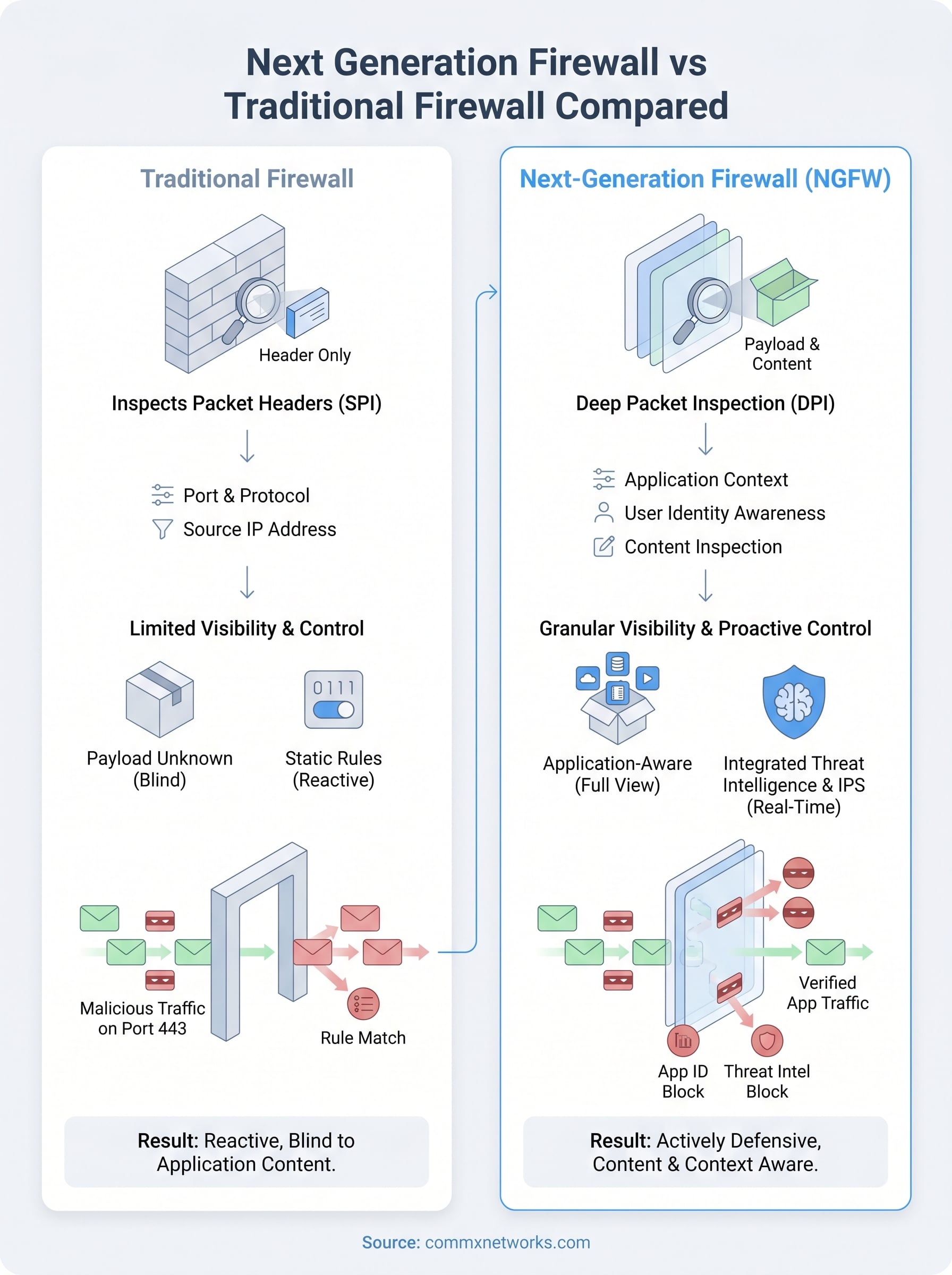
Traditional firewalls operate on a fixed set of rules. They examine packet headers to decide whether to allow or block traffic based on source IP address, port number, and protocol. If a packet matches an approved rule, it passes; if it doesn’t, the firewall drops it. This model served businesses well for years, but it was built for a simpler threat environment.
What traditional firewalls inspect
Traditional firewalls use stateful packet inspection (SPI), which tracks active connection states rather than evaluating each packet alone. They monitor TCP handshakes and session data to verify that incoming packets belong to an established connection. Inspection stops at the network and transport layers; the firewall never examines the content inside the packet.
Where traditional firewalls fall short
In the next generation firewall vs traditional firewall comparison, the central limitation is application-layer visibility. Traditional firewalls see the port a packet uses, not the application driving it. Malicious traffic routed through port 443 looks identical to standard HTTPS traffic, and the firewall has no mechanism to separate the two.
When your firewall cannot see what is inside the traffic, it cannot stop what it cannot identify.
How next-generation firewalls work
Next-generation firewalls build on stateful inspection and extend analysis into higher layers of the network stack. Where a traditional firewall stops at the transport layer, an NGFW examines the application layer to inspect the actual content and context of your traffic rather than just the packet header.
Deep packet inspection and application awareness
Deep packet inspection (DPI) allows an NGFW to read the payload inside each packet, not just its header. This gives your firewall the ability to identify specific applications generating traffic, even when those applications run on standard ports like 443.
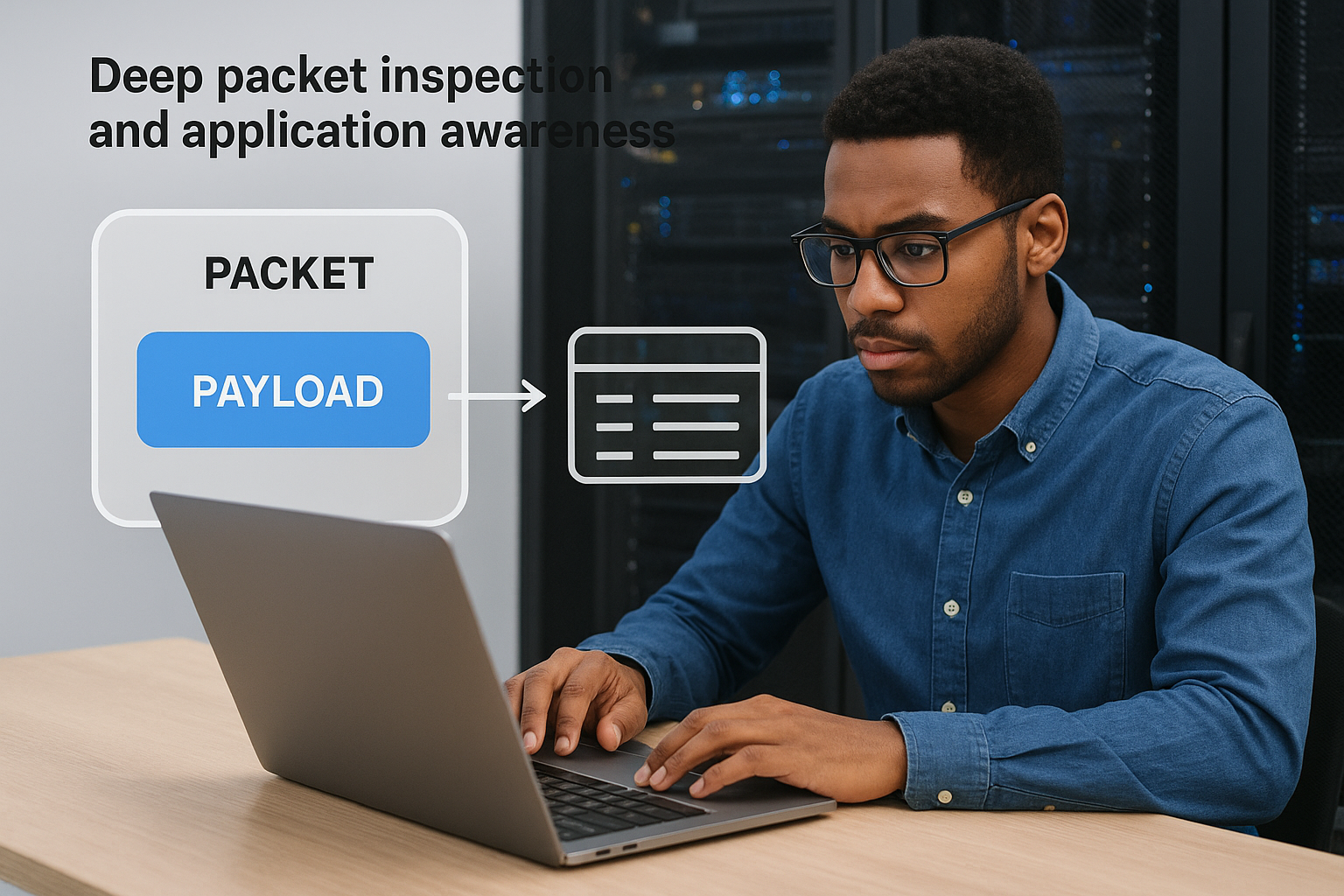
Application awareness means your firewall can enforce policies based on what an application actually is, not just which port it uses. That distinction sits at the core of the next generation firewall vs traditional firewall comparison, and it fundamentally changes how your network handles both legitimate and malicious traffic.
Integrated threat intelligence
NGFWs integrate intrusion prevention systems (IPS) and real-time threat intelligence directly into the firewall engine. Your network traffic gets compared against known attack signatures and behavioral patterns as it flows through the device.
When your firewall can identify and act on threats in real time, your network shifts from reactive to actively defensive.
These intelligence feeds update continuously, which means your firewall responds to new attack methods without requiring manual rule rewrites. For commercial facilities running high-volume data traffic, that level of automated response significantly reduces your exposure window.
Key differences that impact security and ops
When you stack the next generation firewall vs traditional firewall comparison side by side, the most significant gaps appear in visibility, control, and operational burden rather than raw performance numbers.
Visibility and control
Traditional firewalls give you a binary view: traffic either matches a rule or it does not. NGFWs provide granular visibility into what applications run on your network, which users generate traffic, and what that traffic contains. That shift from port-based decisions to application and identity-aware policies lets your security team act on real information instead of guesswork.
Knowing what is on your network is the first step toward controlling what can hurt it.
| Feature | Traditional Firewall | NGFW |
|---|---|---|
| Traffic inspection | Port and protocol | Application and content |
| User identity awareness | No | Yes |
| Threat intelligence integration | No | Yes |
Performance and management overhead
Traditional firewalls are simpler to configure and typically faster at processing raw packet volumes. NGFWs consume more processing power because deep packet inspection adds computational load, though modern NGFW hardware handles that overhead efficiently.
Centralized policy management and automated threat response reduce the manual workload your IT team carries daily. For commercial facilities running high-volume data traffic across large physical footprints, that reduction in hands-on management often offsets the added hardware cost over time.
How to choose and roll out the right firewall
The right firewall for your facility depends on traffic volume, application diversity, and the size of your attack surface. If your network runs a handful of standard business applications with predictable traffic patterns, a traditional firewall may still hold up. Once you add cloud services, IoT devices, or remote access, the next generation firewall vs traditional firewall decision typically resolves in favor of an NGFW.
Assess your network before you buy
Start by auditing your current traffic and application mix. Identify which applications your team uses daily, how many devices connect to your network, and whether you handle sensitive data that falls under regulatory requirements. That inventory gives you a clear picture of what your firewall needs to inspect and control.
Key factors to assess before selecting a firewall:
- Application diversity across your facility
- Number and type of connected devices
- Regulatory or compliance requirements
Plan the rollout in stages
Deploy your NGFW in monitoring mode first before enforcing policies. This lets you capture real traffic patterns without disrupting operations. Once you validate your policy rules against actual traffic, you can enforce them with confidence and avoid blocking legitimate business applications during the cutover.
Buying a firewall without understanding your traffic first is like installing a lock without knowing what you are protecting.
Next steps
The next generation firewall vs traditional firewall comparison comes down to one practical question: does your current firewall see what is actually moving through your network? If your facility runs cloud applications, IoT devices, or remote access connections, the answer almost certainly favors an NGFW. Upgrading your firewall without addressing the physical network infrastructure beneath it, however, limits how much protection you actually gain.
Your firewall is only as effective as the structured cabling and network design supporting it. Gaps in your physical layer create blind spots that no software-defined policy can close. Before you finalize any security upgrade, make sure your cabling, access points, and LAN architecture are built to handle the traffic volumes your NGFW will inspect.
If you want to evaluate your current network infrastructure before making that decision, contact the team at CommX Networks to schedule an on-site consultation for your Southwest Florida facility.